

DJI Matrice 400 vs Matrice 350 RTK – Complete Comparison
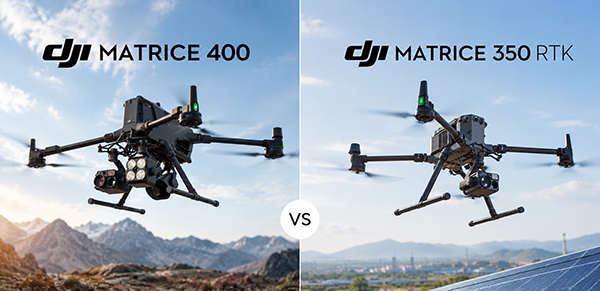
DJI Matrice 400 vs Matrice 350 RTK: compare flight time, payload capacity, obstacle sensing, transmission and Zenmuse compatibility to choose the right enterprise drone platform.
DJI Matrice 400 and DJI Matrice 350 RTK are two heavy-duty enterprise drone platforms designed for professional mapping, surveying, inspection, public safety and specialised industrial operations.
The Matrice 350 RTK remains a proven and highly capable platform, while the newer DJI Matrice 400 introduces substantially higher payload capacity, longer endurance, a new obstacle sensing architecture and support for DJI's latest Zenmuse L3 LiDAR system.
This comparison explains the most important differences and what they mean in real professional operations.
DJI Matrice 400 vs Matrice 350 RTK: specifications
| Specification | DJI Matrice 350 RTK | DJI Matrice 400 |
|---|---|---|
| Maximum flight time | Up to 55 min | Up to 59 min |
| Maximum payload | 2.7 kg | 6 kg |
| Maximum horizontal speed | 23 m/s | 25 m/s |
| Ingress protection | IP55 | IP55 |
| Operating temperature | -20°C to 50°C | -20°C to 50°C |
| Maximum flight altitude | Up to 7000 m* | Up to 7000 m* |
| Obstacle sensing | Six-directional binocular vision + infrared sensing | Omnidirectional vision + rotating and upper LiDAR + mmWave radar + 3D infrared sensing |
| Maximum simultaneous payloads | Up to 3 | Up to 7 |
| Zenmuse L2 | Supported | Supported |
| Zenmuse L3 | Not supported | Supported |
*Maximum altitude depends on aircraft configuration, take-off weight, propellers and operating conditions. Flight-time figures are DJI laboratory values and actual endurance varies with payload, weather, mission profile and other factors.
Payload capacity: 6 kg vs 2.7 kg
One of the biggest differences is payload capacity. The Matrice 350 RTK supports up to 2.7 kg, while the Matrice 400 increases this to 6 kg.
The difference is important for operators using multiple sensors, specialised third-party equipment or more complex payload combinations. Matrice 400 features three underside gimbal connectors and four external E-Port V2 ports, allowing up to seven payloads to be mounted simultaneously depending on the configuration.
The Matrice 350 RTK can carry up to three payloads simultaneously and remains highly versatile for conventional inspection, thermal imaging, photogrammetry and LiDAR missions.
Flight endurance
DJI specifies a maximum flight time of up to 55 minutes for the Matrice 350 RTK. Matrice 400 extends maximum endurance to up to 59 minutes.
The difference on paper is four minutes, but maximum flight-time figures alone do not tell the whole story. Payload weight, wind, temperature, altitude and mission speed all affect real endurance.
The Matrice 400 was designed around heavier professional payloads and long-duration enterprise missions, making its combination of endurance and increased payload capacity particularly important for large-area mapping and complex inspection operations.
Obstacle sensing and flight safety
The Matrice 350 RTK uses a six-directional binocular vision system combined with infrared sensing. An optional CSM Radar can further improve detection of smaller obstacles.
Matrice 400 introduces a substantially different sensing architecture combining omnidirectional full-colour vision sensors, horizontal rotating LiDAR, upper LiDAR, a downward 3D infrared range sensor and six-direction mmWave radar.
This is particularly relevant for demanding infrastructure missions where cables, power lines, towers and complex structures may be difficult for conventional vision systems to detect reliably.
Zenmuse L2 and L3 compatibility
Both platforms support the DJI Zenmuse L2, making both suitable for professional LiDAR surveying and mapping.
The major difference is DJI Zenmuse L3. DJI currently specifies the L3 exclusively for the Matrice 400 platform.
Zenmuse L3 combines a 1535 nm long-range LiDAR, dual 100 MP RGB mapping cameras and a high-precision POS system. Its maximum detection range reaches up to 950 m under DJI's specified test conditions.
For organisations planning to move toward high-altitude, large-area LiDAR acquisition, L3 compatibility can therefore be one of the most important differences between the two aircraft.
Is the Matrice 350 RTK still relevant?
Absolutely. The DJI Matrice 350 RTK remains a capable enterprise platform and supports professional payloads including Zenmuse H30/H30T, L2, P1 and several earlier Zenmuse systems.
For an organisation that already owns M350 aircraft, TB65 batteries, charging infrastructure and compatible payloads, continuing to operate the platform can make strong operational and economic sense.
Matrice 400 becomes particularly interesting when the mission requires heavier or multiple payloads, the newest sensing technology, greater ecosystem expansion or Zenmuse L3.
Which platform fits which mission?
| Application | Matrice 350 RTK | Matrice 400 |
|---|---|---|
| Standard enterprise inspection | Excellent fit | Excellent fit |
| Thermal inspection | Excellent fit | Excellent fit |
| Photogrammetry | Excellent fit | Excellent fit |
| Zenmuse L2 LiDAR | Supported | Supported |
| Zenmuse L3 LiDAR | Not supported | Supported |
| Heavy specialised payloads | Up to 2.7 kg | Up to 6 kg |
| Complex multi-payload missions | Up to 3 payloads | Up to 7 payloads |
Conclusion
The Matrice 400 does not make the Matrice 350 RTK obsolete. Instead, it extends DJI's enterprise platform into missions requiring more payload capacity, more advanced obstacle sensing, expanded connectivity and next-generation sensors such as Zenmuse L3.
For existing M350 operators, the decision to upgrade should therefore be based on mission requirements rather than specifications alone. If L2, P1 or H30-series payloads already cover your operational needs, the M350 remains a highly capable platform. If you need Zenmuse L3, heavier payloads or the expanded M400 ecosystem, the Matrice 400 offers a significant step forward.
Explore the DJI Matrice 400, DJI Matrice 350 RTK, Zenmuse L2 and Zenmuse L3 or contact KopterWorx for advice on configuring a professional DJI Enterprise system.
Powered by Mirasvit Magento 2 Extensions
- DJI Matrice 400 vs Matrice 350 RTK – Complete Comparison
-
 DJI Zenmuse L2 vs L3: Which LiDAR System Is Right for You?
-
 DJI AP100 Parachute for Matrice 400 – C5/C6 Compliance, Safety and Full Overview
-
 Najboljši DJI dron 2026 – Kateri izbrati?
-
 Best DJI Drone 2026 Comparison – Neo 2, Avata 2, Mini 5 Pro, Air 3S, Mavic 4 Pro