

DJI AP100 Parachute for Matrice 400 – C5/C6 Compliance, Safety and Full Overview
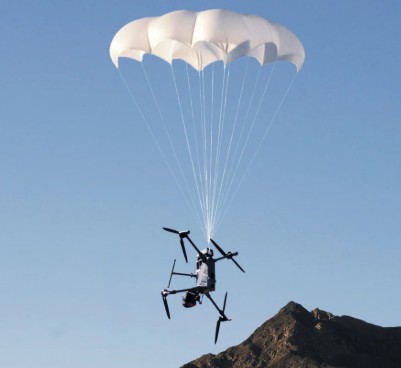
The DJI AP100 Parachute is an integrated emergency recovery system for the Matrice 400, featuring automatic and manual deployment, independent backup power, full-link redundancy and a response time below 600 ms. Learn how it supports C5/C6 operations, affects flight time and improves safety during professional drone missions.
DJI AP100 Parachute for Matrice 400 – C5/C6 Compliance, Safety and Full Overview
The DJI AP100 Parachute is DJI Enterprise’s first dedicated parachute recovery system, developed specifically for the DJI Matrice 400.
Unlike a basic aftermarket parachute, the AP100 is fully integrated into the aircraft’s safety architecture. It has its own sensors, independent backup power, redundant communication and both automatic and manual deployment options.
For operators flying near people, buildings, industrial facilities or valuable infrastructure, the AP100 adds an important additional layer of protection. It is also a key component for operators planning missions under European C5/C6 or UK UK5/UK6 operational requirements.
What Is the DJI AP100 Parachute?
The DJI AP100 is a purpose-built parachute recovery system for the Matrice 400.
It is installed on the rear upper section of the aircraft and communicates directly with the drone’s flight-control and Flight Termination System.
During a critical emergency, the system can:
- detect abnormal aircraft behaviour,
- stop the motors,
- confirm that the propellers have stopped,
- activate the gas generator,
- eject and deploy the parachute.
The goal is not necessarily to save the drone without damage. Its primary purpose is to reduce descent speed and impact energy, helping limit the risk to people, property, infrastructure, the aircraft and its payload.
DJI clearly states that the AP100 reduces risk but cannot completely eliminate the possibility of injury or damage.
Key DJI AP100 Specifications
| Specification | DJI AP100 |
|---|---|
| Compatible aircraft | DJI Matrice 400 |
| Weight with bracket | Approx. 935 g |
| Dimensions | 182 × 171 × 157 mm |
| Maximum supported takeoff weight | 15.8 kg |
| Automatic deployment response time | ≤ 600 ms |
| Stabilised descent speed | ≤ 5 m/s |
| Minimum effective deployment altitude | ≥ 30 m |
| Operating temperature | -20°C to 50°C |
| Operating altitude | 0 to 4,500 m |
| Protection rating | IP55 |
| Parachute material | Nylon |
| Deployment | Automatic or manual |
| Independent backup power | Approx. 1 hour |
The descent-speed and deployment-altitude figures were measured by DJI under controlled conditions with the Matrice 400 at its maximum takeoff weight. Real-world performance may vary with wind, temperature, altitude, payload and aircraft configuration.
Automatic Parachute Deployment
The AP100 continuously monitors flight data from both the aircraft and its own integrated sensors.
Automatic deployment can be triggered when the system detects serious flight anomalies, including:
- abnormal pitch or roll angles,
- unusually high descent speed,
- loss of stable aircraft attitude,
- crossing a configured geocaging boundary.
The AP100 includes its own IMU and safety algorithms. Data from the parachute and aircraft is cross-checked to reduce the possibility of an unnecessary or accidental deployment.
Once the deployment sequence begins, the Flight Termination System stops the motors before the parachute is released. This helps prevent the spinning propellers from damaging or becoming entangled with the parachute lines.
Important automatic-deployment limitation
Automatic deployment is disabled in certain situations close to the Home Point to reduce the risk of deploying the parachute into nearby people, equipment or structures.
DJI states that automatic deployment may be disabled when the aircraft is:
- within a 10-metre radius of the Home Point, and
- within 15 metres above or below the Home Point.
A similar restriction applies when Cleaning Mode is active.
This means the operator must not assume that automatic deployment will be available in every situation. Manual intervention may still be required.
Manual Deployment Through DJI Pilot 2
The pilot can manually deploy the AP100 through DJI Pilot 2.
Deployment is initiated with an on-screen slider, reducing the likelihood of accidental activation while still allowing a rapid response during an emergency.
Manual deployment can be valuable when the pilot identifies a serious problem before the aircraft reaches the automatic-deployment threshold.
Examples could include:
- visible structural damage,
- a payload becoming unstable,
- partial propulsion failure,
- severe aircraft vibration,
- unexpected loss of controllability,
- an approaching geocaging or operational boundary.
The system cannot be manually or automatically activated while the aircraft is still on the ground before takeoff.
Remote FTS Deployment Through DJI FlightHub 2
In supported countries, the AP100 can also be deployed through the Flight Termination System interface in DJI FlightHub 2.
For this function, the Matrice 400 requires a DJI Cellular Dongle 2 and an active 4G connection. The remote controller must also be connected through a Cellular Dongle 2 or Wi-Fi.
An authorised operator enters the aircraft serial number and verification code in the FlightHub 2 FTS interface to trigger flight termination and parachute deployment remotely.
This capability is particularly relevant for:
- BVLOS operations,
- centrally managed drone fleets,
- remote command centres,
- missions where a separate safety operator monitors the aircraft.
DJI lists Slovenia among the supported countries for FlightHub 2 FTS deployment.
Deployment in 600 Milliseconds or Less
DJI specifies an automatic-deployment response time of 600 milliseconds or less.
This measurement covers the complete sequence from:
- activation of the Flight Termination System signal,
- confirmation that all rotors have stopped,
- activation of the parachute gas generator.
This rapid response is important because a fully loaded Matrice 400 can begin losing altitude very quickly after propulsion is terminated.
However, fast deployment does not remove the need for sufficient height. The parachute still requires time and vertical distance to eject, inflate and stabilise the aircraft.
Minimum Effective Deployment Altitude: 30 Metres
DJI specifies a minimum effective deployment altitude of 30 metres.
At or above this height, the parachute has sufficient vertical distance to open and stabilise the Matrice 400 to a descent speed of 5 m/s or less under DJI’s test conditions.
Below 30 metres, the parachute may still eject, but it may not fully inflate before impact.
This is especially important during:
- low-altitude facade inspections,
- bridge inspections,
- flights between buildings,
- industrial inspections close to structures,
- takeoff and landing,
- work below tree or roof height.
The AP100 should therefore not be treated as a complete safety solution for very low-altitude operations. Flight planning, controlled ground areas and obstacle avoidance remain essential.
Stabilised Descent Speed Below 5 m/s
When deployed at an altitude of at least 30 metres, DJI specifies a stabilised descent speed of 5 m/s or less.
Testing was performed with the Matrice 400 at its maximum supported takeoff weight of 15.8 kg in a windless environment.
A descent speed of 5 m/s is still a significant impact. The drone and payload may be damaged or destroyed during landing.
However, compared with an uncontrolled free fall, the parachute can substantially reduce impact energy and the potential consequences for the area below.
This is particularly important when carrying expensive payloads such as:
- DJI Zenmuse H30T,
- DJI Zenmuse P1,
- DJI Zenmuse L2 or L3,
- third-party sensors,
- industrial cameras,
- specialised measurement equipment.
The AP100 is therefore primarily a risk-mitigation system, not a guarantee of damage-free recovery.
Independent Power and Full-Link Redundancy
One of the AP100’s most important advantages is that it does not rely entirely on the Matrice 400’s main power and control systems.
The parachute has:
- an independent flight-control system,
- its own IMU and onboard sensors,
- dual redundant power,
- redundant communication links,
- built-in system monitoring.
Its internal capacitors provide approximately one hour of backup power when fully charged.
This allows the AP100 to continue monitoring aircraft attitude and retain deployment capability even if the aircraft loses its primary electrical power or E-Port connection.
Continuous Safety Self-Checks
The AP100 begins monitoring its status when the Matrice 400 is powered on and continues throughout the flight.
The system checks components including:
- gas-generator status,
- communication links,
- internal electronics,
- power condition,
- connection with the aircraft.
Warnings are displayed through the Health Management System in DJI Pilot 2.
This allows the pilot to identify a fault before takeoff rather than discovering that the parachute is unavailable during an emergency.
A parachute system should always be included in the operator’s formal pre-flight checklist, even when DJI Pilot 2 reports normal status.
Audible and Visual Alarm After Deployment
After deployment, the AP100 activates a continuous audible and visual alarm.
The alarm can operate for approximately one hour and serves two purposes:
- warning people on the ground to remain clear of the aircraft,
- helping the operator locate the drone after an emergency landing.
A physical button on the parachute can be used to stop the light and sound alarm after the aircraft has been recovered and made safe.
C5 and STS-01 Compliance
Installing the AP100 on an existing compatible Matrice 400 allows the aircraft configuration to meet the operational safety requirements associated with C5 in the European Union and UK5 in the United Kingdom.
C5 is primarily associated with STS-01, which covers VLOS operations over a controlled ground area in a populated environment.
Typical STS-01 applications may include:
- urban mapping,
- facade inspection,
- infrastructure inspection,
- emergency-response operations,
- construction-site monitoring,
- industrial inspection in populated locations.
However, installing the AP100 does not by itself authorise a mission.
The operator must still satisfy all applicable requirements relating to:
- operator registration,
- pilot competency,
- STS declaration,
- controlled ground area,
- operational procedures,
- emergency-response procedures,
- remote identification,
- geo-awareness,
- local airspace restrictions.
The AP100 helps provide the required aircraft configuration, but legal compliance still depends on the complete operation.
C6 and STS-02 Compliance
C6 is associated with STS-02, which supports certain BVLOS operations over a controlled ground area, normally in a sparsely populated environment and with the required airspace-observer arrangements.
There is an important distinction:
Installing an AP100 on an existing standard Matrice 400 provides C5/UK5 capability, but it does not convert that aircraft into a C6/UK6-certified model.
For C6 or UK6 operations, DJI specifies that the operator must purchase the factory-certified DJI Matrice 400 (C6) Worry-Free Plus Combo.
The C6 class label applies to the complete factory-certified aircraft configuration and cannot be obtained simply by adding the parachute to an existing Matrice 400.
Practical compliance overview
| Aircraft configuration | Supported requirement |
|---|---|
| Existing Matrice 400 with AP100 installed | C5 / UK5 |
| Matrice 400 C6 Worry-Free Plus Combo | C5/C6 and UK5/UK6 |
| Standard Matrice 400 without AP100 | Not converted to C5 or C6 by software alone |
Effect on Matrice 400 Flight Time
The AP100 weighs approximately 935 grams, so it has a measurable effect on flight endurance.
DJI specifies:
- Matrice 400 maximum flight time without AP100: up to 59 minutes
- Matrice 400 maximum flight time with AP100 and H30T: approximately 53 minutes
This represents a reduction of around six minutes under DJI’s controlled test conditions.
Actual flight time will depend on:
- payload,
- wind,
- temperature,
- altitude,
- flight speed,
- battery condition,
- use of RTK or cellular transmission,
- mission profile.
For many professional missions, the reduction in endurance may be an acceptable trade-off for improved operational access and safety.
Maximum Takeoff Weight and Payload Planning
The AP100 supports a maximum aircraft takeoff weight of 15.8 kg, which matches the Matrice 400 maximum takeoff weight.
The total aircraft weight includes:
- Matrice 400,
- both batteries,
- AP100 and mounting bracket,
- gimbal and camera,
- additional payloads,
- cables, adapters and accessories.
Operators must calculate the complete takeoff weight before every mission.
The installation of the AP100 does not increase the Matrice 400’s maximum takeoff weight. Its approximately 935-gram mass must be included within the existing 15.8 kg limit.
The standard Matrice 400 supports payloads of up to 6 kg under specified conditions, but available payload capacity can decrease with altitude and installed accessories.
Effect on Obstacle Sensing
The AP100 installation introduces an important operational limitation.
When the parachute is installed, the Matrice 400 automatically disables its:
- downward mmWave radar,
- backward mmWave radar.
This prevents the radar system from interfering with parachute deployment and reduces the risk of false obstacle detections.
However, it also means the aircraft’s ability to detect smaller obstacles below and behind it is reduced.
Pilots must therefore pay additional attention when:
- reversing,
- descending,
- flying close to buildings,
- operating near wires,
- flying close to cranes or industrial structures,
- landing in confined areas.
Visual sensors and other obstacle-sensing functions may still be available, but the pilot must understand that the complete Matrice 400 obstacle-sensing capability is changed while the AP100 is mounted.
IP55 Weather Protection
The AP100 has an IP55 protection rating, matching the professional outdoor design of the Matrice 400.
This means it is designed to resist limited dust ingress and water jets under controlled test conditions.
However, IP55 does not mean the system is waterproof, and the protection level may decrease over time due to:
- wear,
- impact,
- damaged seals,
- incorrect installation,
- ageing,
- improper maintenance.
The parachute should always be inspected after rain, transport, hard landings or any event that could affect its enclosure or mounting system.
Is the DJI AP100 Reusable?
No.
The AP100 is a single-use safety device.
After any deployment, the complete parachute system must be replaced. It is not sufficient to repack only the canopy or replace the gas generator.
DJI also recommends retiring and replacing the AP100 three years after activation, even when the system continues to pass its normal self-checks.
Operators should include this replacement interval in their maintenance records and fleet operating costs.
Who Should Consider the DJI AP100?
The AP100 is particularly relevant for operators working in:
Public safety
Police, firefighters, civil protection and emergency-response teams frequently fly near people, buildings and critical infrastructure.
Energy and utilities
Power-line, substation, wind-turbine and industrial inspections often involve expensive payloads and operations near valuable equipment.
Surveying and mapping
C5 operations can provide new possibilities for surveying in populated or urban environments where a standard Open Category operation is not sufficient.
Construction and infrastructure
The parachute can add an additional mitigation layer during bridge, roof, tower and large construction-site inspections.
BVLOS fleet operations
The C6 Matrice 400 configuration can support operators planning STS-02 missions, subject to all additional operational and regulatory requirements.
High-value payload missions
Even where C5 or C6 compliance is not required, reducing the energy of an uncontrolled descent may be valuable when the Matrice 400 carries expensive sensors.
Advantages of the DJI AP100
The strongest advantages include:
- official DJI integration,
- automatic and manual deployment,
- Flight Termination System integration,
- independent backup power,
- redundant communication,
- continuous self-diagnostics,
- response time of 600 ms or less,
- stabilised descent speed of 5 m/s or less,
- C5/UK5 support for existing Matrice 400 aircraft,
- support for C6/UK6 through the factory C6 package,
- IP55 protection,
- direct status monitoring in DJI Pilot 2.
Compared with a non-integrated parachute, the AP100 provides a more complete connection between aircraft detection, motor shutdown and parachute deployment.
Limitations to Consider
The AP100 also introduces several limitations:
- approximately 935 g of additional weight,
- flight time reduced by around six minutes,
- minimum effective deployment altitude of 30 m,
- no guarantee against aircraft or payload damage,
- downward and backward mmWave radar disabled,
- complete replacement required after deployment,
- recommended replacement after three years,
- C6 certification cannot be added retrospectively to a standard Matrice 400,
- full legal compliance requires more than installing the parachute.
These limitations should be considered during aircraft selection, payload planning and operational risk assessment.
DJI AP100 vs Third-Party Parachute Systems
The main advantage of the AP100 is not only the canopy itself. It is the depth of integration with the Matrice 400.
A typical third-party system may have its own sensors and independent trigger, but the DJI AP100 can work directly with:
- aircraft flight data,
- DJI Pilot 2,
- Flight Termination System,
- DJI FlightHub 2,
- aircraft Health Management System,
- geocaging,
- motor-stop confirmation.
This integrated approach can simplify installation, system checks, pilot training and operational documentation.
Third-party systems may still be suitable for specific authorisations or aircraft configurations, but compatibility and regulatory acceptance must be verified separately.
Is the DJI AP100 Worth It?
For basic flights in isolated areas, the AP100 may not be necessary for every operator.
For professional Matrice 400 users, however, it can provide value in three major areas:
1. Improved operational safety
The AP100 adds an independent emergency system designed to reduce the consequences of a catastrophic aircraft failure.
2. Access to C5 operations
Existing Matrice 400 owners can add the AP100 to meet C5/UK5 aircraft safety requirements for applicable STS-01 operations.
3. Protection of business operations
A serious drone accident can result in aircraft loss, payload damage, third-party damage, investigation and interruption of operations. A parachute does not eliminate these risks, but it may substantially reduce their consequences.
For organisations flying regularly near populated areas or valuable infrastructure, the AP100 is likely to become one of the most important Matrice 400 accessories.
Frequently Asked Questions
Is the DJI AP100 compatible with the Matrice 350 RTK?
No. DJI lists the AP100 as compatible only with the DJI Matrice 400.
Can the AP100 be installed on an existing Matrice 400?
Yes. Installing it on an existing compatible Matrice 400 allows the configuration to meet C5/UK5 operational safety requirements.
Does adding the AP100 make an existing Matrice 400 C6-certified?
No. C6/UK6 requires the factory-certified DJI Matrice 400 C6 Worry-Free Plus Combo.
What is the minimum deployment altitude?
DJI specifies a minimum effective deployment altitude of 30 metres.
How fast does the Matrice 400 descend after deployment?
DJI specifies a stabilised descent speed of 5 m/s or less when deployed at 30 metres or higher under its test conditions.
Can the pilot deploy the parachute manually?
Yes. The pilot can deploy it in DJI Pilot 2. Remote FTS deployment through DJI FlightHub 2 is also available in supported regions with the required network configuration.
Will the drone be undamaged after landing under the parachute?
Not necessarily. The drone and payload may still be damaged. The purpose of the AP100 is to reduce descent speed and impact consequences.
Can the parachute be reused?
No. The complete AP100 must be replaced after deployment.
How often should the AP100 be replaced?
DJI recommends replacing it three years after activation, even if it has never been deployed and continues to pass its self-checks.
Does the AP100 affect flight time?
Yes. DJI specifies approximately 53 minutes with the AP100 and H30T, compared with up to 59 minutes without the parachute under comparable test conditions.
Conclusion
The DJI AP100 Parachute transforms the Matrice 400 from a powerful enterprise drone into a platform capable of supporting a broader range of regulated and safety-critical operations.
Its combination of automatic deployment, manual control, independent power, redundant sensors, Flight Termination System integration and C5/C6-related configurations makes it significantly more advanced than a simple add-on parachute.
The system does introduce additional weight, reduced flight time and changes to obstacle sensing. It also cannot guarantee that the aircraft or payload will survive an emergency landing.
Nevertheless, for professional operators working near populated areas, expensive infrastructure or high-value payloads, the AP100 provides a meaningful additional safety layer and a clearer route towards compliant STS-01 and STS-02 operations.
Powered by Mirasvit Magento 2 Extensions
- DJI AP100 Parachute for Matrice 400 – C5/C6 Compliance, Safety and Full Overview
-
 Najboljši DJI dron 2026 – Kateri izbrati?
 -
 Best DJI Drone 2026 Comparison – Neo 2, Avata 2, Mini 5 Pro, Air 3S, Mavic 4 Pro
 -
 DJI Mini 5 Pro Review (2026) – Best Lightweight Drone?
 -
 DJI Mavic 4 Pro Review – Is It Worth It in 2026?