

Drone as First Responder: How DJI Dock Changes Alarm Response

Drone as First Responder sends an aircraft to the incident before the ground team. See how DJI Dock, Matrice 5TD and FlightHub 2 reshape alarm response.
When an alarm is triggered, the longest delay often happens before anyone can see what is actually taking place. Drone as First Responder (DFR) changes the order: an aircraft reaches the location first and sends live aerial video, allowing the operations centre to size the ground response using real information.
In a Dock as First Responder model, the aircraft is already positioned close to its operating area. A remote pilot or operator supervises the automated task, watches the live feed and can intervene when needed. The goal is not to replace police, fire, rescue or security teams. It is to give them useful information earlier.
From alarm to live aerial intelligence
| Step | What happens | Operational value |
|---|---|---|
| 1. Alarm or call | An incident enters through a dispatch centre, sensor or connected system. | The process starts without waiting for a pilot to drive to the launch site. |
| 2. Verification and dispatch | An authorised person validates the task; a supported workflow can dispatch the aircraft through FlightHub 2. | Responsibility and mission initiation remain clear and traceable. |
| 3. Flight and live feed | The aircraft flies to the incident while the operator monitors position, video and system health. | Situational awareness develops while ground units are still travelling. |
| 4. Decision | The centre distinguishes a false alarm, a limited incident or an urgent threat. | The appropriate team deploys with better information and priority. |
| 5. Return and record | The aircraft returns to the dock; mission data and logs remain available under the operator's governance rules. | The response becomes repeatable, reviewable and auditable. |
What do DJI Dock 4 and Matrice 5TD add?
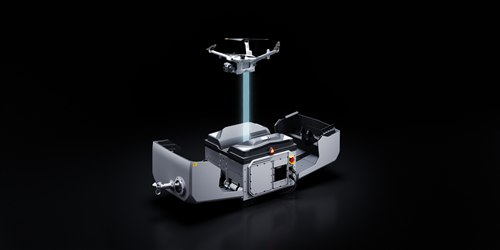
DJI Dock 4 and Matrice 5TD are designed for repeated remote missions. Dock 4 swaps the aircraft battery in under 25 seconds. Matrice 5TD combines daylight cameras, thermal imaging, a tele camera, laser rangefinder, LiDAR and mmWave radar. That sensor mix matters for missing-person searches, fire assessment, industrial alarms and night operations where a single type of camera is not enough.
FlightHub 2 brings task planning, live video, location, alerts and mission records into one operational view. DJI also describes automated Dock 4 workflows that can trigger a mission from a third-party alert. A real deployment should retain a clearly defined human validation step, responsibility and abort path between the alarm and takeoff.
Where is DFR most useful?
Public safety
- traffic collisions and access-route assessment,
- missing-person searches and support for field teams,
- early views of fires, smoke and hazardous areas,
- situational awareness during higher-risk incidents.
Private and industrial security
- perimeter-alarm verification,
- coverage of logistics parks, ports and large warehouses,
- inspection of energy sites before personnel enter,
- targeted night patrols instead of constant vehicle movement.
How much sooner can the picture arrive?
DJI's DFR material gives an example of about 3–5 minutes for an aircraft from a pre-positioned dock inside the coverage area, compared with roughly 10–30 additional minutes for a pilot to drive to the incident with an aircraft. These are not guaranteed response times. Distance, weather, airspace, connectivity, system readiness and local operating approval determine the real result.
DJI similarly states that one pilot may supervise up to four active dock operations in mature procedures where regulations and operating limits allow it. Staffing should therefore be based on risk assessment, workload and contingency procedures rather than the maximum technical capability alone.
Five areas to prepare before deployment
- Purpose and coverage: define the alarm types, required response time and realistic coverage of each dock.
- Site readiness: assess visibility, obstacles, wind, power, network connectivity, backup links and physical security.
- Operating approval: establish the applicable flight scenario, competent personnel, airspace arrangements, lost-link procedures and emergency actions.
- Data and privacy: define users, access, retention, audit records and limits on recording.
- Integration and testing: prove one site first, then connect dispatch, video, mapping and reporting systems.
When is a mobile pilot still the better choice?
A dock does not fit every mission. Dynamic incidents outside the coverage area, indoor spaces, highly complex environments, specialist payloads and cases where a pilot is already on scene may require a conventional mobile aircraft team. Strong programs usually combine automated coverage for repeatable tasks with mobile pilots for exceptions.
Planning DFR or automated site security?
KopterWorx can help assess the site, coverage, sensors, connectivity and the appropriate DJI Dock configuration. Contact us for a technical project review and pilot-deployment plan.
-
 DJI AP100 Parachute for Matrice 400: Safety and C5/C6 Guide AP100 adds an integrated emergency parachute to Matrice 400. Understand deployment limits, maintenance and the important difference between C5 and C6 configurations.
-
 DJI Zenmuse L2 vs L3: Which LiDAR System Is Right for You? Compare DJI Zenmuse L2 and L3 by range, returns, cameras, accuracy and aircraft compatibility. Match the LiDAR workflow to your survey requirements.
-
 DJI Matrice 400 vs Matrice 350 RTK – Complete Comparison DJI Matrice 400 vs Matrice 350 RTK: compare flight time, payload capacity, obstacle sensing, transmission and Zenmuse compatibility to choose the right enterprise drone platform.
-
 DJI Matrice 5T Is Here: 59 Minutes, Native 1K Thermal and IP55 DJI Matrice 5T brings 59-minute flight time, native 1280 × 1024 thermal imaging, IP55 protection and a new combination of LiDAR, radar and advanced cameras. See what it means for demanding operations.
Powered by Mirasvit Magento 2 Extensions
- DJI Matrice 5T Is Here: 59 Minutes, Native 1K Thermal and IP55
- Drone as First Responder: How DJI Dock Changes Alarm Response
-
 DJI Dock 4 and Matrice 5TD: What 25-Second Battery Swaps Change
- DJI Matrice 400 vs Matrice 350 RTK – Complete Comparison
- DJI Zenmuse L2 vs L3: Which LiDAR System Is Right for You?